
December 29, 2025

As per Times Higher Education 2024, Australia offers 22,000+ courses across all levels with 41 universities, including 38 ranked in the global top 1000. Popular choices to study in Australia for Pakistani students include Business, IT, Engineering, Law, and Health. Most universities require a minimum IELTS 6.0 for bachelor’s and 6.5 for master’s, along with at least 60% marks in previous studies. Bachelor’s degrees usually take 3–4 years, master’s 1–2 years, and PhDs 3–4 years. Average tuition fee ranges from AUD $20,000–$45,000 per year, with living costs of around AUD $1,500–$2,500 per month. Students must show a bank statement of AUD $24,505, while partial scholarships (15%–50% of tuition) help reduce overall costs. With a visa success rate of around 85%, the Subclass 500 student visa is typically processed within 1–4 weeks, making Australia a highly accessible option for international students and Pakistani students as well —especially when guided by the best Australian consultant in Lahore, who help Pakistani students choose the right course, manage documents, and strengthen their visa applications.

Quick Facts of Study in Australia 

Language of Instruction  English 
Popular Cities 
  • Sydney
  • Melbourne
  • Brisbane
  • Perth
  • Adelaide 
Degree Duration 
  • Bachelor: 3–4 yrs
  • Master: 1–2 yrs
  • PhD: 3–4 yrs 
Top Universities 
  • University of Melbourne
  • ANU (Australian National University)
  • University of Sydney
  • Monash University
  • University of Queensland 
Popular Programs 
  • Business
  • IT
  • Engineering
  • Law
  • Health Sciences
  • Nursing
  • Data Science
  • Accounting 
Tuition Fees  AUD $20,000–$45,000/year 
Partial Scholarships Merit-based 15%–50% tuition fee reduction 

(varies by university)

Visa Type Subclass 500 
Living Costs  AUD $1,500–$2,500/month 
Work Rights  48 hrs/fortnight during classes 
Post-Study Visa  Subclass 485 (Temporary graduate visa) 
Eligibility  60–70% marks + IELTS 6.0/6.5 
Bank Statement Required  AUD $24,505 for 12 months 
Visa Processing Time  1–4 weeks 

Study in Australia Fees for Pakistani Students

The cost of studying in Australia depends on your course and institution, so here is a complete breakdown of tuition fees for Pakistani students.

Program  Annual Tuition (AUD) 
Diploma / Certificate  $10,000 – $18,000 
Bachelor’s Degree  $20,000 – $35,000 
Master’s Degree  $22,000 – $45,000 
PhD  $25,000 – $40,000 
Medical Programs  $50,000 – $80,000 

🎯 Tip: If you are searching for the cheapest university in Australia, regional universities offer lower fees and excellent scholarship options. 

List of Top Universities in Australia

Below are the Cheapest universities in Australia for Pakistani students, along with their popular programs and approximate annual fees: 

University  Popular Programs  Average Annual Fees (AUD) 
University of Melbourne  Law, Business, Health, Arts  $35,000 – $55,000 
Australian National University (ANU)  Science, IR, Politics  $34,000 – $50,000 
University of Sydney  Medicine, Engineering, Arts  $36,000 – $60,000 
University of Queensland  Biology, Pharma, IT  $32,000 – $48,000 
Monash University  Nursing, Education, Engineering  $30,000 – $50,000 
University of Western Australia  Mining, Geology, Marine Science  $28,000 – $45,000 


Bonus: Australia also has excellent regional universities offering lower tuition fees (AUD $20,000 – $32,000/year) and easier admission criteria, making them great options for budget-focused international students.

Scholarships in Australia for Pakistani Students

Australia offers a wide range of scholarships for Pakistani students in 2025, helping reduce tuition fees and living costs across top universities.


Scholarship  Coverage  Offered By 
Australia Awards  Full tuition + living allowance  Australian Govt. 
Destination Australia 

Scholarship 

Up to $15,000/year  Govt + Institutions 
University Merit 

Scholarships 

25% – 100% tuition  Individual Universities 
RTP 

(Research Training Program) 

Full tuition + stipend  Australian Govt. 

Many Pakistani students secure partial or full scholarships based on academic merit and English proficiency. 

Cost of Living in Australia for Students 
Cost of Living in Australia for Pakistani Students 

Monthly cost estimate: 

Accommodation  $120 – $700 
Transportation  $12 – $70 
Food  $80 – $300 
Entertainment  $50+ 

Average monthly expenses range from AUD $1,800–$2,500 depending on the city.

Step-by-Step Admission Process to study in Australia 

Applying to study in Australia is a smooth and simple process when you follow the right steps. To make your journey easier, Pakistani students can also get support from top educational consultants in Pakistan, who guide you from choosing the right university to securing your visa. They ensure your entire application is accurate, timely, and meets Australian study visa requirements. These student abroad services often include:

Here’s an easy, step-by-step guide to help you through the Australian admission process:

Choose Your Program & University

The first step in your Australia journey is to choose the right program and university based on your interests, budget, and future career plans. Australia offers thousands of degrees in fields like Business, IT, Engineering, Health, Nursing, and Law, so it’s important to research properly. A great place to start is the CRICOS (Commonwealth Register of Institutions and Courses for Overseas Students) website, which lists all government-approved institutions and courses for Pakistani students. 

Through CRICOS, you can check whether a course is officially registered, compare tuition fees, entry requirements, course duration, and city options, and see if the university is eligible to sponsor your student visa. For Pakistani students, taking help from the best Australia consultants in Lahore can make this step even easier, as they guide you toward suitable universities that match your profile, marks, and budget.

Check Entry Requirements

Before you apply, make sure you meet the entry requirements for your chosen course and university. Each institution sets its own criteria, but generally:

  • You should have at least 60% or above in your previous academic qualifications.
  • Most undergraduate programs require IELTS 6.0 overall, while postgraduate programs usually need IELTS 6.5 or higher.
  • Many universities also accept PTE, TOEFL, or Duolingo as alternatives to IELTS.
  • Your background subjects should match your chosen field (e.g., science for engineering, commerce for business).

Meeting these requirements strongly increases your chances of an offer letter and visa approval.

Prepare Documents

Before applying, you must prepare all required documents for Australia university admission, ensuring they meet the guidelines of your chosen institution.

  • Academic transcripts and certificates
  • Valid passport
  • SOP (Statement of Purpose)
  • English language test results (eg, IELTS, PTE)
  • Letters of recommendation ((2–3, depending on the course)
  • CV (for postgraduate applicants)

Receive Offer Letter & Pay Deposit

After your application is approved, the university will issue an offer letter (conditional or unconditional). Once you accept the offer and pay the required tuition deposit, the university will generate your Confirmation of Enrolment (CoE). This CoE is a crucial document—it officially confirms your admission and is mandatory for your Australia study visa (Subclass 500) application.

Apply for Australian Student Visa (Subclass 500)

With your Confirmation of Enrolment (CoE) ready, you can now apply online for the Australian student visa (Subclass 500). The main Australia study visa requirements include:

  • Valid CoE (Confirmation of Enrolment)
  • Bank statement of AUD $24,505 (minimum funds for 12 months)
  • OSHC (Overseas Student Health Cover)
  • GTE (Genuine Temporary Entrant) statement
  • Visa application fee payment and passport

On average, visa processing takes around 1–4 weeks, depending on your case and time of year.

Book Your Flight & Prepare for Australia

Once your visa is granted, you can book your flight and finalize your pre-departure arrangements. This includes:

  • Arranging accommodation (on-campus, homestay, or shared rental)
  • Planning your finances and budget
  • Buying travel and health insurance (if needed beyond OSHC)
  • Organizing airport pick-up and keeping all important documents handy

This final step ensures a smooth and stress-free arrival in Australia so you can start your studies with confidence.

Study and Work in Australia

Australia offers excellent work opportunities for Pakistani students, allowing them to support their living costs while gaining practical experience. 

  • Students can legally work 48 hours per fortnight during academic sessions. 
  • Unlimited work hours during semester breaks, giving them the flexibility to manage studies and part-time employment. 

Many Australian universities also provide career development services, including 

  • On-campus job fairs
  • Resume workshops
  • Internship placement support
  • Industry networking events. 

These services help students secure part-time jobs in retail, hospitality, administration, tutoring, IT support, and more—building valuable experience alongside their degree.

Career Prospects & PR Pathways in Australia

Australia’s growing economy provides strong career prospects and has strong job opportunities for graduates across multiple high-demand fields. Sectors such as 

  • Engineering
  • IT & Cybersecurity
  • Healthcare & Nursing
  • Business & Accounting
  • Education
  • Construction & Architecture 

It consistently offers excellent employment opportunities with competitive salaries. After completing their degree, students can apply for the Temporary Graduate Visa (Subclass 485), which allows them to live and work in Australia for up to 4 years, depending on their qualification level. This work experience boosts eligibility for several skilled migration programs, including:

  • Skilled Independent Visa (Subclass 189)
  • Skilled Nominated Visa (Subclass 190)
  • Regional Sponsored Visa (Subclass 491)
  • Employer-Sponsored PR Pathways

For many graduates, the 485 visa becomes the first step toward long-term residency, regional sponsorship, or fulfilling requirements for Permanent Residency (PR) in Australia.

Best Cities to Study in Australia

Australia offers some of the world’s most student-friendly cities—each known for its quality education, job opportunities, and affordable lifestyle. Whether you want top-ranked universities, budget-friendly living, or strong PR pathways in Australia, these cities offer excellent options for international students.

Top Cities for Pakistani Students in Australia 
Top 5 Cities for Pakistani Students in Australia 

City  Why It’s the Best Choice 
Melbourne  Best student city, cultural hub, top universities, 

strong part-time job market 

Sydney  Home to highly ranked universities, global business opportunities, 

vibrant lifestyle 

Brisbane  Affordable living, warm climate, modern campuses, ideal for budget-conscious students 
Perth  High job opportunities, strong economy, peaceful environment, 

great for work in Australia 

Adelaide  Regional benefits, cheaper accommodation, easier PR pathways, 

top research institutions 

FAQs 

Can Pakistani students study in Australia after Matric/10th?

Yes, through foundation programs or Diploma-to-degree pathways.

What academic gap is accepted?

The Under Graduate gap is accepted 1–2 years and the Post Graduate gap is accepted 3–5 years (with justification)

What is a GTE (Genuine Temporary Entrant) statement for Australia?

A GTE statement is a short document required for the Subclass 500 student visa, where you explain your genuine intention to study in Australia, your academic background, and your plan to return home after your studies.

Can I take dependents with me?

Yes, you can bring your spouse and children, but you must show additional funds.

How long can I stay after graduation?

Subclas 500 is only for students who want to study in Australia but after applying Subclass 485 allows 2–4 years depending on your qualification and city.

Which is the cheapest university in Australia?

Universities in regional areas such as Charles Darwin University, University of Southern Queensland, and Federation University offer lower tuition.

What is OSHC and is it mandatory?

 OSHC (Overseas Student Health Cover) is required for all international students in Australia. It provides essential medical and hospital insurance during your stay and is a mandatory visa requirement.

What is a Subclass 500 Student Visa?

The Subclass 500 is Australia’s main student visa, allowing Pakistani students to study full-time for up to 5 years and work part-time alongside their course.

What is the difference between 500 and 485 visas?

The 500 visa is a student visa for studying in Australia with limited work hours, while the 485 visa is a post-study work visa that lets you stay and work full-time in Australia after you graduate.

December 5, 2025

The UK’s new immigration policy for 2025–2027 brings some of the biggest changes in years, affecting international students, skilled workers, care workers, and asylum seekers. The reforms reduce the Post-Study Work (PSW) visa from 2 years to 18 months, raise the English language requirement from B1 to B2 for many routes, and remove dependents for most taught Master’s and undergraduate students. ILR is extended from 5 to 10 years, with a new salary-based fast track, while low-paid health and social care workers may wait up to 15 years for nationality. Stricter university ratings and temporary-only asylum rules further reshape who can study, work, and settle in the UK.

Overview Table – Major UK Immigration Changes (2025–2027)

Category Old Rules New Rules
Post-Study Work Visa (Graduate Route) 2-year duration Reduced to 18 months
PSW for PhD Graduates 2 years 3 years
Student Work Hours 20 hrs/week 25 hrs/week
Student Dependents Allowed in most degrees Only for PhD & research students
English Requirement – Dependents No A1 needed A1 mandatory
English Requirement – Skilled Worker B1 B2 required
ILR (Settlement) 5-year qualifying period 10 years (most applicants)
ILR Based on Salary Not salary-dependent £125K salary = ILR in 3 yrs
£50K–£125K = 5 yrs
Care Worker & Low-Pay Visa Nationality Normal timeline May take 15 years to qualify for nationality
Asylum Nationality Eligible after 5 years refugee status No UK nationality; visa renewed every 2.5 years
University Sponsorship System General compliance Red-Amber-Green rating (strict)
Visa System Standard online New digital application portal
Financial Requirements Previous lower threshold Higher funds required for 28 days

UK New Immigration Policy for Students – Study & Work Changes (2025–2026)

Big changes are coming for students who want to study in UK and work in the UK. The new rules reduce PSW duration, restrict dependents, and raise English requirements, making it important to plan ahead.

Financial Requirements Increasing

From November 2025, the UK is increasing the financial proof requirements for student visas, meaning students must show higher funds for both living costs and the full first-year tuition fee as stated on their CAS (Confirmation of Acceptance for Studies).

For living expenses, you’ll need to prove:

  1. £1,483 per month (up to 9 months) if you are studying in London
  2. £1,136 per month (up to 9 months) if you are studying outside London.

This money must remain in your bank account for at least 28 consecutive days, and the last day of that 28-day period must fall within 31 days before you submit your visa application.

The funds can come from your own bank savings, a student loan, or official financial sponsorship, and if you are bringing dependents, you must show additional funds to cover their living costs as well. In simple words, you now need more money, held for a stricter fixed period, to prove you can afford to study and live in the UK.

Graduate Route (PSW) Reduced

Previous rule New rule
2-year PSW visa 18 months only
Applies until 31 Dec 2026 New rule applies 1 Jan 2027

Important: Anyone who applies after 1 January 2027 will receive only 18 months PSW, except PhD graduates, who will still get 3 years PSW.

What does this mean for students?

You will have less time to:

  • Find a suitable job
  • Secure a Skilled Worker visa sponsorship

You’ll need to:

  • Plan your career path earlier
  • Actively network with employers during your course
  • Focus on high-demand sectors that are more likely to sponsor visas

Student Work Hours Increased

One of the most student-friendly updates in the new UK immigration policy is the extension of working hours during term time. Under the revised rules:

  • Previous limit: 20 hours per week
  • New limit: 25 hours per week
  • Effective from: November 2025

This change allows students to earn more, gain valuable work experience, and build stronger connections with employers while completing their studies.

Dependents Policy Restricted

The rules for bringing family members (spouse and children) on a student visa have become more restrictive.

What’s changing?

Previously, many postgraduates and some other students could bring dependents. But under the new system, this right is expected to remain mainly for:

  • Research postgraduate students
  • Doctoral (PhD) students

For most undergraduate and taught Master’s students, dependents will no longer be eligible for visas under the new rules. This will particularly affect families who were planning to move together.

Higher English Language Requirements

The UK is raising English language standards for both students and workers, especially for those who want to stay long term or bring family.

Visa Type New Level
Student Dependents A1 minimum
Skilled Worker B1 → B2 (from Jan 2026)

For many students, skilled workers, and their dependents, the UK is now expecting a stronger command of English, especially at B2 level on the CEFR scale for most main routes.

  • IELTS (International English Language Testing System)
  • SELT (Secure English Language Test)

This change is designed to ensure better academic performance, employability, and integration into UK society.

University Sponsorship Compliance Overhaul

The way the UK evaluates universities that sponsor international students is also changing. UK universities will now be assessed using a tiered compliance model:

Rating Category Meaning & Impact
🟥 Red-Rated Institutions
  • Restricted from recruiting new international students
  • At risk of losing sponsorship rights if performance does not improve
🟧 Amber-Rated Institutions
  • Under close monitoring
  • Must improve compliance to avoid restrictions or becoming Red-rated
🟩 Green-Rated Institutions
  • Maintain full sponsorship privileges
  • Considered reliable, trusted, and compliant sponsors

Indefinite Leave to Remain (ILR): Extended Timeline

A significant change in the new policy is the shift in the ILR (settlement) timeline.

  • Old rule: Most applicants could qualify for ILR after 5 years.
  • New proposal: Many routes may now require 10 years of lawful residence before ILR.
  • Healthcare workers & dependents must wait 15 years to get nationality.

Salary-Based Fast-Track ILR

The UK New Immigration Policy has introduced a new salary-based fast-track system for permanent residency (ILR), allowing higher earners to qualify much faster than others. The system is tougher for everyone, but it clearly sends one message: the higher your earnings, the faster your route to ILR and long-term settlement.

Annual Salary ILR Timeline
£125,000+ 3 years
£50,000–£125,000 5 years
Below £50,000 10-year route applies

Note: A petition with 188,526 signatures opposed the 10-year ILR policy, but the government did not reverse it.

Asylum & Refugee Policy – New Rules (2026)

The “Asylum & Refugee Policy – New Rules (2026)” outlines important changes in the UK’s approach to asylum seekers and refugees. As part of the UK New Immigration Policy, these updates aim to streamline the process and ensure a fairer, more efficient system for those seeking protection in the country.

Old System New System
  • Refugees received a 5-year visa
  • Then became eligible for British nationality
  • Refugees will not be granted nationality
  • They will receive temporary protection visas
  • Visa will be reviewed every 2.5 years
  • They will only stay until their home country becomes safe

📌 Britain will allow asylum seekers to remain protected but not settle permanently.

Faqs

Will current students still get a 2-year Post-Study Work Visa (PSW)?

Yes. Students graduating before the new rules take effect are expected to keep the full 2-year PSW. The 18-month PSW applies from January 2027 for new applicants.

What is a Petition?

A petition is a formal request signed by the public asking the government to make a change. If it gains 100,000+ signatures, Parliament must debate it but they are not required to change the law.

Can simple Master’s students bring dependents?

Mostly no. Under the new rules, dependents are mainly allowed for PhD and research students only.

What English level is required under the new rules?

The Student dependents require minimum A1 and skilled worker visa raised from B1 to B2 (effective January 2026)

Will asylum seekers get UK nationality under new rules?

No. From 2026, asylum seekers will receive temporary protection only, not automatic citizenship. Their status will be reviewed every 2.5 years.

November 22, 2025

The UK remains a top destination for Pakistani students, and with the help of top educational consultants in Pakistan, you can easily cross the application process, secure the best scholarships, and prepare for a successful study journey. With over 35,500 study visas issued in 2024 alone, a significant rise over the past 5 years. The UK offers world-class universities like the University of Oxford, University of Cambridge, Imperial College London, and University College London (UCL), studying in the UK offers academic and cultural opportunities. However, for the 2026–27 academic year, new changes to visa requirements, including higher bank statements (up to £1,529/month for London), stricter rules for dependents, and adjustments to the Graduate Route (post-study work visa), will affect the application process. Key requirements include IELTS or TOEFL for English proficiency, and scholarships like Chevening, Commonwealth, and GREAT offer valuable financial support. This guide covers the latest UK study visa requirements, tuition fees (ranging from £11,400 to £30,000), cost of living in the UK (£900 to £1,400/month), and the best affordable universities, making it easier for Pakistani students to plan their study journey to the UK.

Quick Facts: Study in UK for Pakistani Students (2026–27)

Language of Instruction  English 
Intakes for Admissions September, October
Visa Ratio
  • Student Visa:  98%
  • Dependent Visa: 86%
  • Visitor Visas: 77%
Degree Duration 
  • Bachelor’s: 3 years 
  • Master’s: 1 year (most) 
  • PhD: 3–4 years 
Top UK Universities 
  • University of Oxford
  • University of Cambridge
  • Imperial College London
  • University College London (UCL)
  • University of Edinburgh
  • University of Manchester 
Top Courses for Pakistani Students 
  • Business
  • Engineering
  • Computer Science
  • Data Science
  • Medicine
  • Nursing
  • Finance 
Average Tuition 

(per year) 

  • Bachelor’s: £11,000–£22,000
  • Master’s: £12,000–£26,000 
Scholarships 
  • Chevening
  • Commonwealth
  • GREAT
  • University-specific merit-based scholarships 
IELTS/English Language Requirement  IELTS Academic (6.0–6.5) or 

TOEFL iBT (80–100) 

Living Cost  Approx £900–£1,300/month outside London, £1,300–£1,800/month in London
UKVI Maintenance 

(visa calculation, from 11 Nov 2025) 

£1,529/month in London, £1,171/month outside London, 

up to 9 months, 

plus tuition for the first year, held for 28 days.

UK student working 

hours

Up to 20 hours/week in term time, full-time in vacations, for degree-level Student visa holders.
Minimum Wage 

(2025 baseline) 

Around £10–£12.21/hour depending on age
Post-Study Work (Graduate Route)  Upto 2 years for most degrees 
Visa Processing Time  Commonly around 3 weeks (via UK Student Visa) .
Visa Fee  £348 (standard) + Immigration Health Surcharge (IHS) for healthcare coverage 
Bank Statement  Minimum £3,000 at least 28 days before the 

visa application date

Why Pakistani Students Choose the UK

The UK offers:

  • 1-year Master’s and 3-year Bachelor’s – fast return on investment
  • Degrees recognised worldwide in IT, business, engineering, health and finance
  • A large Pakistani community in cities like London, Birmingham, Manchester, Leeds and Glasgow
  • Part-time work rights: most degree-level students can work up to 20 hours per week in term-time and full-time in vacations

For 2026–27, the UK is still a strong option – but rules and costs have changed, so planning correctly is very important.

Top UK Universities for Pakistani Students 

The UK is home to several prestigious and affordable universities offering a wide range of programs for pakistani students. If you’re looking for affordable universities in the UK, here are some excellent choices: 

Top 10 UK Universities for Pakistani Students

University Name  Top Programs Offered  Annual Tuition (Est.) 
University of Oxford  Law, Humanities, Medicine  £25,000 – £38,000 
University of Cambridge  Engineering, Mathematics, Business  £22,000 – £30,000 
Imperial College London  Science, Technology, Engineering  £28,000 – £38,000 
University College London (UCL)  Arts, Architecture, Social Sciences  £20,000 – £30,000 
University of Edinburgh  Business, Arts, Education  £18,000 – £25,000 
Leeds Beckett University  Business, Media, Sports  £12,000 – £16,000 
University of Sunderland  Business, Nursing, Computing  £14,000 – £17,000 
Teesside University  Engineering, Games, Animation, Business  £13,000 – £16,000 
University of Chester  Business, Health, Computing  £13,000 – £16,000 
University of Bolton  Engineering, Business, Health  £12,000 – £16,000 

These universities not only offer competitive tuition fees but also provide high-quality education and good career prospects for Pakistani students. 

Scholarships for Pakistani Students in the UK

Studying in the UK can be costly, but several scholarships can help fund your education. Here are some popular options:

Scholarship Name  Coverage  Eligibility 
Chevening 

Scholarships 

Tuition, living costs, 

and airfare 

Open to students from Chevening-eligible countries 
Commonwealth Scholarships  Tuition, living costs, and airfare  For students from Commonwealth countries 
University-Specific Scholarships  Varying coverage, merit-based  Offered by individual UK universities 
British Council Scholarships  Tuition, living, and travel costs  Open to students in various fields, based on nationality and program 

Tip: Apply early to increase your chances of receiving a scholarship, as funds are often limited. 

UK Admission Process for Pakistani Students

Applying to study in the UK is a straightforward process if you follow the right steps. To make your journey to the UK smoother, you can seek guidance from top educational consultants in Pakistan. They offer a range of services to ensure your application and visa process go smoothly. These student support services include:

Here’s an easy guide to help you through the admission process:

Research and Choose a Program

The first step is to choose a university and program that aligns with your academic interests and career goals. Take your time to research universities and their offerings.

Prepare Application Documents

You’ll need the following documents to complete your application:

  • Academic transcripts
  • English proficiency test scores (e.g., IELTS or TOEFL)
  • Statement of Purpose
  • Letters of Recommendation (LOR)
  • Passport-sized photos

Submit Your Application

  • Undergraduate Programs: Apply through UCAS (Universities and Colleges Admissions Service).
  • Postgraduate Programs: Apply directly through the university’s website.

Await the Offer

Once you receive your offer letter, confirm your enrollment by paying the tuition deposit. After confirmation, start preparing for your UK Student Visa application.

UK Student Visa Process

Once you’ve received your admission offer, follow these steps to apply for your UK Student Visa:

Gather Required Documents

Before applying for your visa, ensure you have the following documents ready:

  • Official admission letter from your university
  • Valid passport
  • English language proof (IELTS marks)
  • Financial proof (bank statement showing £1,171/month for living costs outside London or £1,529/month for London)
  • Health insurance coverage
  • Proof of accommodation in the UK
  • Passport-sized photos

Submit Your Visa Application

Apply online through the UK Government’s visa portal and pay the visa fee and biometric fee (if applicable). Ensure all documents are submitted correctly to avoid delays.

Visa Decision

Visa processing typically takes around 3 weeks. You will be notified via email about the decision.

Prepare for Travel

Once your visa is granted, make your travel arrangements to the UK. You’ll be allowed to enter the UK up to a month before your course starts.

Tip: Always apply for your visa well in advance to avoid last-minute stress.

Post-Study Work Opportunities in the UK

The Graduate Visa offers a fantastic opportunity to stay and work in the UK after completing your degree:

  • Graduate Visa: This visa allows pakistani students to stay for 2 years after completing their degree to work or look for a job.
  • For PhD Graduates: The post-study work period is extended to 3 years.

This visa gives graduates the chance to gain valuable work experience in the UK, enhancing their global career prospects.

Faqs

Can I go to the UK without IELTS?

Yes, you can study in the UK without IELTS. Some universities accept alternatives like a Medium of Instruction (MOI) letter from your previous institution may also be accepted. However, you will need to pass the IELTS test for your UK student visa interview.

Can you get a 100% scholarship in the UK?

While 100% scholarships are rare, you can receive university-specific scholarships that may cover tuition fees. StudyWes consultants can help you find the best opportunities based on your qualifications.

How much is the 1-hour salary in the UK for Pakistani students?

The minimum wage in the UK for students is typically between £10 to £12.21/hour depending on age and type of job. Many Pakistani students work part-time in retail, hospitality, or on-campus jobs to support their living expenses.

Can I bring my family on a UK student visa?

You can bring your family (spouse and children) as dependents if you’re studying at a postgraduate level (Master’s or PhD) for a course lasting more than 12 months. They will need to apply for a separate visa and meet the financial requirements.

Which course is highly demanded in the UK?

The UK has a strong demand for graduates in STEM fields (Science, Technology, Engineering, and Mathematics), particularly in Data Science, Artificial Intelligence, Engineering, Cybersecurity, and Nursing. These sectors offer excellent career prospects and post-study work opportunities.

Can I get UK PR in 2 years?

It is not possible to obtain Permanent Residency (PR) in the UK within 2 years. However, after completing a Skilled Worker Visa or a Graduate Visa, you can apply for Indefinite Leave to Remain (ILR) after 5 years of living and working in the UK.

What is the easiest scholarship to get?

The easiest scholarship to get depends on your qualifications and the university. University-specific scholarships are often easier to obtain as they are merit-based and vary in value. 

What are the reasons for UK visa rejection?

Common reasons for UK visa rejection include:

  • Insufficient financial proof
  • Incomplete or incorrect application
  • Lack of evidence for genuine study intent
  • Failure to meet English language requirements
  • Previous visa violations or immigration history

Is IELTS necessary for a UK visa?

Yes, IELTS is a standard requirement for the UK Student Visa. It proves your English proficiency and is used by most universities in the UK for admission

Which course is cheaper in the UK?

Business, social sciences, and humanities courses are generally more affordable compared to medicine, engineering, and science programs. Choosing a university outside London can also lower your tuition and living costs.

How much are average UK rent prices?

The Outside London: £350 – £700/month for shared accommodation and Inside London: £800 – £1,500/month for shared accommodation or student halls

Do you help provide classes for IELTS preparation?

Yes, top educational consultants in Pakistan offer IELTS preparation classes to help you achieve the required scores for UK study visas. These classes focus on improving your English skills (listening, reading and writing) exam strategies to ensure you pass with the best score.


September 9, 2025

Learning English, whether as a second language or to improve your existing skills, can be both exciting and challenging. With so many tools available online, it’s important to choose the right English learning resources that suit your style. In this guide, we’ll explore the best books, apps, and websites to learn English, along with practical tips to boost your grammar, vocabulary, listening, and speaking skills.

Best Books for Learning English

Books remain one of the most effective ways to build a strong foundation. Here are some of the top English learning books:

  • English Grammar in Use by Raymond Murphy
    Perfect for beginners and intermediate learners, this book explains grammar clearly with exercises to practice. It’s one of the most recommended English grammar books worldwide.
  • Word Power Made Easy by Norman Lewis
    If you want to improve your English vocabulary, this book helps you break down complex words into easy parts, making learning memorable.
  • Oxford English Dictionary & Merriam-Webster Dictionary
    Essential for mastering word meanings, pronunciation, and usage. A must-have for serious learners.
  • Fluent English by Barbara Raifsnider
    Designed for advanced learners who want to sound more natural, this book covers idioms, slang, and conversational English.

Best Apps to Learn English

Mobile apps make learning English engaging and flexible. Here are the top English learning apps:

  • Duolingo – Fun, game-style lessons for vocabulary and grammar.
  • Babbel – Focused on practical, real-life conversations.
  • HelloTalk – Lets you practice English with native speakers.
  • Memrise – Great for memorizing words and phrases quickly.
  • Busuu – Offers structured courses with speaking practice.

Best Websites to Learn English Online

Websites give you access to lessons, exercises, and authentic English content. Some of the best websites for English learning include:

  1. BBC Learning English – Free daily lessons, videos, and quizzes.
  2. EnglishClub – Grammar, vocabulary, and pronunciation guides.
  3. Grammarly Blog & Writing Assistant – Helps improve writing and grammar in real-time.
  4. FluentU – Learn English through real-world videos with subtitles.
  5. English Stack Exchange – Community-driven answers to English questions.
  6. Coursera & edX – Free and paid online English courses from top universities.

How to Use These Resources Effectively

Simply using these resources is not enough—you need the right approach:

  • Start with a grammar foundation – Use books like English Grammar in Use.
  • Practice daily – Spend 15–30 minutes on apps like Duolingo or Babbel.
  • Immerse in real content – Watch BBC Learning English or FluentU videos.
  • Engage with natives – Use HelloTalk or Busuu to improve fluency.

Consistency is the key to success. Even 20 minutes a day can help you achieve noticeable progress.

Conclusion

Mastering English requires a mix of quality resources and regular practice. From grammar books and vocabulary builders to English learning apps and websites, the options are endless. Choose the tools that fit your learning style, stay consistent, and combine them for the best results. With time and effort, you’ll see your English fluency, grammar, and vocabulary improve significantly.

July 7, 2025

Introduction

More Pakistani students are asking, “What’s next?” after graduation. For many, a master’s degree is the answer. It offers personal growth, better job prospects, and global exposure. Despite economic challenges and inflation, interest in foreign education is at an all-time high. Many aim to settle abroad, gain skills, or boost their CV. But the process can feel overwhelming with so many options. This guide is for Pakistani students planning a master’s in 2025. It will help you make informed decisions, choose the right country and course, understand scholarships and visas, and avoid common mistakes.

Choose the Right Country

Deciding where to study is a big step. The country should match your goals, budget, and plans. Here’s a breakdown of top choices for Pakistani students in 2025.

United Kingdom

Master’s programs are usually one year long. You get a two-year post-study work visa. However, tuition and living costs in cities like London are high. Look into Chevening, Commonwealth, or university scholarships to save money. Best for those wanting a short program and quick career growth.

Canada

Canada is popular for its permanent residency options. Many master’s programs lead to PR pathways. Scholarships and assistantships are available. Programs last 1.5 to 2 years with good job prospects. The visa process is straightforward if you apply early. Best for students seeking long-term settlement.

Australia

Australia offers flexible student visa rules and work rights. Its job market is stable, and universities are diverse. Costs are similar to Canada. Check out Destination Australia or university-specific scholarships. Best for quality education and a multicultural environment.

United States

The US has top universities, especially in tech, business, and law. Visa approvals are competitive for Pakistanis, and funding is limited. Tuition and living costs are high. Best for students aiming for elite academics who can handle visa challenges.

Budget-Friendly Options

For affordability, consider Germany, where public universities have low or no tuition, especially in STEM. Sweden offers scholarships and innovative programs. Malaysia has cost-effective, English-taught courses and a familiar culture. Best for students seeking quality education on a budget.

When choosing, think about your field, budget, work opportunities, and visa approval rates.

Field Selection: Law, Tech, Business, or Something New?

Choosing your field is critical. Should you stick to your bachelor’s field or try something new?

Continuing in the Same Field

Sticking to your field, like an LLM after LLB, deepens expertise. It strengthens your job profile and opens specialized or teaching roles. Best for those passionate about their current path.

Switching Fields

Some students switch from law or humanities to tech, data, or business. An MBA after law suits leadership or corporate roles. Moving to data science or tech works if you have analytical skills. Universities often accept field changes if your Statement of Purpose shows clear intent and skills. Best for those wanting high-growth sectors or feeling disconnected from their degree.

In-Demand Fields for 2025

To make your degree worthwhile, consider booming industries:

– Artificial Intelligence: Powers automation and chatbots.

– Cybersecurity: Companies need protection.

– Data Science: Data skills are highly sought after.

– Climate & Sustainability: Green jobs are growing.

– Financial Technology: Pakistan’s digital banking is expanding.

– Public Policy: Great for law or social science students.

– Healthcare Management: Driven by digital health trends.

Not sure what fits? Ask yourself: What excites you? What’s trending globally? Where do your skills align? Try short online courses in AI, finance, or UI/UX to test your interests.

Exams & Language Requirements

Entrance and language exams are the first step for studying abroad. Here’s what you need.

IELTS / TOEFL

Most universities require English proficiency tests. IELTS scores range from 0–9, with 6.5–7.0 typically needed. TOEFL scores range from 0–120, with 85–100+ required. Practice with free mock tests on IELTS Liz or British Council. Focus on listening and speaking, often weaker areas for Pakistani students. Use apps like IELTS Prep or Magoosh. Scores are valid for two years.

GRE / GMAT

GRE is needed for US programs like engineering or data science. GMAT is for MBA or business analytics at top schools. Some Canadian and European universities accept GRE. Use free resources like Magoosh YouTube or ETS guides. Study in groups to stay motivated. Only prepare if your program requires it, as many are now test-optional.

Preparation Tips

Start studying 3–4 months before the test. Take weekly practice tests. Use free resources first to save money. Avoid relying on agents for prep. Strong scores improve visa approval chances.

Scholarships & Funding

“How will I pay for this?” is a common worry. Many scholarships are available for Pakistani students.

HEC Scholarships

The Higher Education Commission offers fully-funded scholarships, covering tuition, stipend, and travel. Check the HEC website regularly.

Chevening Scholarship (UK)

Fully funded by the UK, it covers tuition, flights, and living expenses. You need two years of work experience and leadership potential.

Commonwealth Scholarship (UK)

For Commonwealth countries like Pakistan, it supports master’s and PhD programs in UK public universities.

Fulbright Scholarship (USA)

Sponsored by USEFP, it’s fully funded and prestigious. A GRE score is required.

University Scholarships

Many universities offer partial tuition waivers or merit awards. Examples include University of Melbourne’s Graduate Research Scholarships, University of Toronto’s merit awards, Swedish Institute Scholarships, and Germany’s DAAD Scholarships. Check each university’s financial aid section.

Financial Planning

Create a budget for tuition, rent, visa fees, and more. Save early in a separate account. Explore HEC or bank loans like NBP or Meezan. Ask family for contributions. Avoid selling assets hastily. Use budgeting tools like Google Sheets or Wallet.

SOPs, LORs, and Applications

Applications can feel overwhelming, but they’re manageable with planning.

Statement of Purpose

Your SOP tells your story. Include who you are, what inspired you, your academic background, why this field and university, and your career goals. Be specific and avoid clichés. Use tools like Grammarly to polish it.

Letters of Recommendation

You need 2–3 LORs from{detachment from professors, internship supervisors, or job managers. Give them 2–3 weeks and share your CV and SOP for tailored letters. Avoid writing them yourself.

Application Deadlines

Fall 2025 deadlines are October 2024 to February 2025. Spring 2026 deadlines are June to September 2025. Track deadlines, documents, and fees in Excel or Notion.

Key Documents

Prepare your passport, transcripts, test scores, SOP, LORs, CV, and experience letters.

Visa Process & Mistakes

The visa process can be stressful, but preparation helps.

Visa Documents

You need a passport, acceptance letter, bank statement, transcripts, test scores, visa form, fee payment, medical insurance, photos, and sometimes a study plan or police certificate.

Common Mistakes

Don’t delay bank statements; funds need 3–6 months in the account. Book medical and biometric appointments early. Get documents attested. Avoid agents’ generic templates. Keep photocopies.

Visa Tips

Be confident in interviews. Explain why this country and university, and your future plans in Pakistan. Show ties to Pakistan like family or job prospects. Be honest to avoid fraud issues. Join forums like r/ukvisa or Pakistani student groups for tips.

Life Abroad

Studying abroad is exciting but challenging.

Culture Shock

Classrooms and social norms may differ. Professors are informal but expect independence. People may seem distant at first. Be open, attend events, and connect with others.

Part-Time Jobs

Common jobs include cafe work, food delivery, or on-campus roles. Each country has work-hour limits. Focus on studies first, as master’s programs are fast-paced.

Homesickness

You’ll miss family and Pakistani culture. Video call home, but not too much. Join Pakistani or desi communities. Budget carefully to avoid financial stress.

Support System

Make diverse friends. Connect with Pakistani seniors or mentors. Join student groups or volunteer to build confidence.

This guide aims to make your master’s journey clearer and achievable in 2025.


Need Guidance or Have Questions?

Feel free to reach out — we’re here to help you plan your master’s journey with clarity and confidence.
📱 Phone / WhatsApp: +92 321 8888850


July 2, 2025

If you’re dreaming of studying abroad in 2025, the IELTS (International English Language Testing System) is likely a crucial step on your path. This globally recognized English language proficiency test is accepted by over 11,000 institutions, including top universities in the UK, Australia, Canada, and Europe. It’s more than just an exam; it’s your essential gateway to international education.

As we move into 2025, the landscape of international student applications is more competitive than ever. Universities are increasingly raising their minimum IELTS band score requirements, and digital IELTS formats like “IELTS on Computer” are rapidly becoming standard. Furthermore, AI-powered evaluation tools are being integrated into some test components, making meticulous and accurate IELTS preparation more critical than ever before.

This comprehensive IELTS guide for 2025 candidates will equip you with effective preparation strategies, updated tips, and a targeted IELTS study plan designed to help you boost your IELTS score significantly.

IELTS 2025 Overview: What You Need to Know

What is IELTS?

The International English Language Testing System (IELTS) is a globally recognized English language proficiency exam. It’s jointly administered by the British Council, IDP: IELTS Australia, and Cambridge English, and is accepted in over 140 countries for academic, immigration, and professional purposes.

Why Do You Need IELTS?

If your goal is to study, work, or migrate to English-speaking countries such as the UK, Canada, Australia, New Zealand, or parts of Europe, a valid IELTS score is frequently a mandatory requirement.

Here’s why it’s so important:

  • UK & Australia: Most universities in the UK and Australia and various visa categories necessitate IELTS Academic.
  • Canada: The IELTS General Training module is widely used for both academic admission and immigration through programs like Express Entry.
  • New Zealand & Ireland: IELTS scores are highly preferred for university admissions and residency pathways.

Without a qualifying IELTS score, your university application or visa process could face significant delays or even outright rejection.

Academic vs. General Training: Understanding the Difference

There are two distinct types of IELTS tests. Choosing the correct one depends entirely on your objective:

Test TypePurposeWho Should Take It?
IELTS AcademicFor higher education or professional registrationStudents applying to universities abroad
IELTS GeneralFor work experience or immigrationIndividuals migrating to English-speaking countries

If you are applying for a bachelor’s, master’s, or PhD program, you will invariably need to take the IELTS Academic version.

Latest Test Format for 2025

The IELTS exam in 2025 maintains its familiar four-section structure:

  1. IELTS Listening – 4 parts, 40 questions (30 minutes)
  2. IELTS Reading – 3 passages, 40 questions (60 minutes)
  3. IELTS Writing – 2 tasks (60 minutes)
  4. IELTS Speaking – 3-part oral interview (11–14 minutes)
  • Total Duration: Approximately 2 hours and 45 minutes
  • Available Formats: You can choose between a Paper-based IELTS test or a Computer-delivered IELTS test, depending on your preference and local availability.

New in 2025: While human examiners remain the standard in most regions, some test centers are currently piloting AI-assisted speaking evaluations.

What’s New in IELTS 2025? Key Updates for Candidates

As IELTS continues to adapt to global education trends, the 2025 edition introduces a few important updates and expectations for all candidates.

No Major Format Changes—But Digital is Rising

The fundamental structure of the IELTS exam (Listening, Reading, Writing, Speaking) remains consistent in 2025. However, there’s a definite and ongoing shift towards computer-delivered IELTS tests, offering benefits like faster results (typically within 3–5 days) and increased test slot availability throughout the month.

Globally, more IELTS test centers are now offering Speaking tests via video calls, particularly for remote locations. This change ensures convenience without compromising the quality or fairness of the test.

AI-Powered IELTS Preparation Tools

While Artificial Intelligence is not yet grading your actual IELTS exam, AI-driven practice tools are becoming an increasingly significant trend. From engaging in mock interviews with chatbots to receiving writing feedback using machine learning algorithms, IELTS 2025 test-takers are encouraged to embrace smarter, technology-based IELTS prep methods.

Some leading IELTS preparation platforms now offer simulated band scoring with over 90% accuracy, providing excellent opportunities for self-assessment.

Expectations from 2025 Candidates

IELTS in 2025 is designed to assess not only your English language proficiency but also your clarity, coherence, and adaptability in real-world communication scenarios. Examiners expect:

  • Natural fluency in Speaking (avoiding robotic or memorized responses)
  • Structured writing with clear arguments and supporting examples
  • Accurate grammar and a diverse vocabulary
  • Effective time management across all sections of the test

With the widespread availability of AI tools for IELTS preparation, candidates are generally expected to be even better prepared, leading to increased competition.

Stay Updated

For the most official IELTS test changes, policy updates, or preparation materials, always refer to the official IELTS website:

  • ielts.org

IELTS Band Score Breakdown: Understanding Your Target

The IELTS scoring system ranges from Band 1 (non-user) to Band 9 (expert user). Each section—Listening, Reading, Writing, and Speaking—is scored individually. The average of these scores determines your Overall Band Score, which is then rounded to the nearest half or whole band.

What Does Each IELTS Band Score Mean?

Band ScoreSkill LevelDescription
9Expert UserDemonstrates fully operational command of the language.
8Very Good UserExhibits occasional inaccuracies, but strong overall control.
7Good UserGenerally effective command with some occasional errors.
6Competent UserPossesses fair command with some mistakes in unfamiliar situations.
5Modest UserDisplays partial command, with frequent communication breakdowns.
4Limited UserShows basic competence, limited to familiar situations.
3 and belowExtremely Limited to Non-UserFrequent breakdowns or no real communication possible.

Target Scores for Top Universities & Countries

Different countries and institutions have varying minimum IELTS score requirements. Here’s a general overview:

CountryStudy LevelMinimum Band Requirement
UKUndergraduate / Master’s6.0–7.5 (Academic)
CanadaCollege / University6.5 overall, with no band less than 6.0
AustraliaUniversity / Permanent Residency6.0–7.0 for study, 6.0+ for immigration
USA (selected)Grad schools (optional)6.5–7.5 (for IELTS-accepting schools)
GermanyEnglish programs6.5–7.0

Pro tip: Some highly competitive top-tier universities (such as Oxford, Cambridge, UCL, or the University of Toronto) may require IELTS scores of 7.0–7.5 or higher, often with specific minimum band scores in each individual section.

In essence, achieving an IELTS score of 7.0 or above not only significantly enhances your chances of admission to top international institutions but also facilitates smoother visa and scholarship applications.

Best IELTS Preparation Tips by Section

To excel in IELTS 2025 and achieve a Band 7+ score, you need more than just English language skills; you need a strategic approach. Here’s a detailed, section-by-section breakdown with proven IELTS tips that can make a substantial difference in your performance.

IELTS Listening Tips

The IELTS Listening section comprises four recordings of increasing difficulty. To perform exceptionally well:

  • Practice with British and Canadian accents: Since IELTS utilizes authentic real-world accents, train your ear using resources like BBC, CBC, and official IELTS recordings.
  • Use official IELTS audio samples: Avoid unreliable online tests. Instead, stick to authoritative sources such as Cambridge IELTS books, IELTS.org, or IDP practice tools for realistic preparation.
  • Write answers as you listen: You will hear the audio only once. Practice active listening with intense focus, and do not wait to hear the information again.

IELTS Reading Tips

The IELTS Reading section assesses your reading speed, comprehension, and ability to extract details. Here’s how to gain an advantage:

  • Master skimming and scanning:
    • Skimming: Reading quickly to grasp the main idea.
    • Scanning: Rapidly finding specific information. Learn to use both techniques efficiently for IELTS Reading.
  • Watch the clock: You have only 60 minutes for 3 lengthy passages and 40 questions. Practice with a timer consistently to build your reading speed.
  • Don’t read everything word-for-word: Focus initially on headings, topic sentences, and keywords present in the questions.

IELTS Writing Tips

The IELTS Writing section is often considered the most challenging. You will complete two distinct tasks:

  • IELTS Writing Task 1 (Academic): Describe a graph, chart, process, or map.
  • IELTS Writing Task 1 (General Training): Write a letter (formal, semi-formal, or informal).
  • IELTS Writing Task 2 (Both Academic & General Training): Write an essay presenting an argument or opinion.

Top IELTS Writing Tips:

  • Know the structure:
    • Task 1: Introduction → Overview → Key points.
    • Task 2: Introduction → Body Paragraphs → Conclusion.
  • Use formal language: Avoid contractions (e.g., “don’t,” “won’t”). Write in complete, well-structured sentences.
  • Practice with high-band model answers: Analyze Band 8–9 sample essays to understand effective vocabulary, coherence, and transitions.

IELTS Speaking Tips

The IELTS Speaking test is a live interview (or video call) with an examiner. Here’s how to perform exceptionally well:

  • Practice with partners or apps: Utilize tools like IELTS Speaking Assistant, or simulate mock interviews with a friend or tutor.
  • Stay confident and natural: Fluency is more important than absolute perfection. If you forget a word, paraphrase or explain your idea.
  • Expand your answers: Avoid giving one-word replies. For example:
    • Instead of: “Yes.”
    • Say: “Yes, especially during weekends when I have free time, I really enjoy it.”
  • Work on pronunciation and intonation: You don’t need a specific accent. The key is to speak clearly with natural stress and pauses.

Create Your IELTS Study Plan (4 Weeks / 8 Weeks Options)

Whether you have just a month or a couple of months to prepare, the cornerstone of IELTS success is a structured and consistent IELTS study plan. Here’s a proven 4-week and 8-week strategy that has helped countless candidates boost their IELTS scores.

4-Week Intensive IELTS Study Plan (For Fast-Track Learners)

WeekGoals & Focus Areas
Week 1Understand the IELTS format. Take a diagnostic IELTS test. Focus on IELTS Listening basics & IELTS Reading techniques.
Week 2Deep dive into IELTS Writing Task 1 & 2. Learn structure, formal tone, and practice IELTS essays.
Week 3IELTS Speaking practice with sample topics. Focus on fluency, vocabulary, and confidence.
Week 4Take full IELTS mock tests under timed conditions. Review weak areas. Focus on IELTS test-day strategy.

8-Week Flexible IELTS Study Plan (For Working Students)

WeekFocus
1–2Learn IELTS test format. Focus on IELTS Listening + IELTS Reading basics.
3–4Start IELTS Writing Task 1 (graphs/letters) + IELTS Speaking introduction.
5–6Move to IELTS Writing Task 2 (essays) + advanced IELTS Listening.
7Practice full IELTS Speaking tests. Timed IELTS Reading drills.
8Full-length IELTS mock exams. Final revision + IELTS exam strategy.

Free & Trusted IELTS Preparation Resources

Here are top free IELTS tools that can guide your daily preparation:

Websites for IELTS Prep

  • IELTS.org: Official test information, IELTS sample papers.
  • IELTS Liz: High-band IELTS model answers and strategies.
  • IELTS Buddy: IELTS Writing samples and grammar tips.

YouTube Channels for IELTS

  • E2 IELTS: Expert video lessons with live classes.
  • IELTS Advantage: Step-by-step tutorials for all four IELTS sections.
  • Asad Yaqub (for Pakistani candidates): Excellent IELTS Speaking & Writing tips in Urdu/English.

IELTS Apps

  • IELTS Prep by IDP
  • BBC Learning English
  • IELTS Speaking Assistant
  • Magoosh IELTS Vocabulary Builder

Pro Tip: Aim to complete one IELTS Writing task and one IELTS Speaking task every day. Alternate between IELTS Listening and IELTS Reading practice. Consistency in your IELTS preparation is far more effective than last-minute cramming, especially when paired with the right tools and a solid plan.

Mistakes to Avoid While Preparing for IELTS

Even the most dedicated students can fall into common traps that can unfortunately lower their IELTS scores. Make sure to avoid these pitfalls:

  • Cramming Vocabulary: Learning hundreds of new words overnight won’t help if you don’t understand how to use them correctly in context. Focus on practical IELTS vocabulary used in real scenarios. Quality over quantity is key for IELTS vocabulary.
  • Ignoring Speaking Practice: Don’t assume that speaking English “in your head” is sufficient. IELTS examiners assess your fluency, coherence, and pronunciation—qualities that can only improve through actual, consistent IELTS Speaking practice.
  • Not Taking Mock Tests Seriously: Many students skip full-length IELTS practice tests or treat them casually. This is a significant mistake. Treat every IELTS mock test like the real examination: use a timer, simulate test conditions, and thoroughly review your mistakes.

Recommended IELTS Resources

Looking for reliable IELTS materials? Here are tried-and-tested tools that students worldwide rely on:

IELTS Books

  • Cambridge IELTS Books (Books 10 to 18 recommended): These provide real past papers with model answers for authentic practice.
  • Barron’s IELTS Superpack: Excellent for detailed, section-wise IELTS strategies.

IELTS Websites

  • IELTS Liz: Highly trusted for IELTS Writing & Speaking tips.
  • Magoosh: Offers structured IELTS study plans and video lessons.
  • British Council: Provides official IELTS sample questions and test information.

IELTS Apps

  • IELTS Prep by IDP
  • E2 IELTS (also has a strong YouTube channel)
  • IELTS Speaking Assistant
  • Magoosh Vocabulary Builder

Final Tips Before IELTS Exam Day

Here’s how to ensure everything runs smoothly on your IELTS test day:

What to Bring for IELTS

  • Your valid passport or ID.
  • Your IELTS confirmation email.
  • Pencil, eraser (if taking the paper-based test).

Mental Preparation & Time Management for IELTS

  • Practice deep breathing techniques to manage anxiety.
  • Arrive early at the test center to remain calm and composed.
  • Read all instructions carefully to avoid common, easily preventable mistakes.

Rest & Routine Before IELTS

  • Aim for at least 7–8 hours of quality sleep the night before your IELTS exam.
  • Eat a light but energy-rich meal before heading to the test center.
  • Avoid last-minute cramming; it primarily increases stress without significant benefit.

Conclusion

Preparing for IELTS 2025 doesn’t have to be an overwhelming experience. With the right strategy, consistent practice, and the comprehensive resources we’ve outlined, you absolutely can reach your target IELTS band score.

Remember: IELTS success is not solely about your English language proficiency; it’s also about understanding the test thoroughly and approaching it with smart, effective strategies.

June 3, 2025

Applying to graduate school for Fall 2025? One of the most important documents you’ll submit is your Statement of Purpose (SOP). In this guide, you’ll learn exactly how to write an SOP that helps you stand out from other applicants and secure your spot at top universities.

Your Key to Grad School: A Winning Statement of Purpose for Fall 2025

Want to get into grad school for Fall 2025? Your Statement of Purpose (SOP) is super important. Think of it as your personal story that helps you stand out. This guide will show you how to write an amazing SOP that gets noticed.

Why Your Statement of Purpose (SOP) Matters for Fall 2025

The SOP is a big part of your graduate school application. It’s your best chance to share your unique story and show why you’re different from other applicants. As universities become more selective for Fall 2025, a well-written SOP can really help you get accepted, even if other applicants have similar grades. This document lets the admissions committee see your drive, your clear goals, and how well you fit with their program.

What Is a Statement of Purpose (SOP) for Grad School?

A Statement of Purpose is a focused, personal essay where you explain:

  • Your background: What you’ve studied and your work experience.
  • Why you’re interested: Your reasons for wanting to study this specific subject.
  • Your future plans: What you want to achieve in your career, both soon and in the long run.
  • Why this university and program: What makes this particular school and program the right choice for you.

The SOP helps admissions officers understand your passion, your potential, and how you’ll contribute to their academic community.

How to Write a Winning SOP for Grad School Applications

A clear and organized SOP is easy to read and effective. Use this structure to guide your writing:

  • Start Strong (Introduction): Begin with a captivating story, a key experience, or a specific moment that sparked your interest in your field. Avoid overused phrases like “Ever since I was young.” Make your opening unique and authentic.
  • Talk About Your Studies (Academic Background): Highlight relevant courses, research projects, or academic achievements that show you’re ready for graduate-level study. Focus on skills and experiences that match what your chosen program requires.
  • Share Your Work Experience (Professional Experience): Describe any internships, jobs, or leadership roles that relate to your academic and career goals. Clearly connect these experiences to why you want to study further.
  • Define Your Career Goals (Aspirations): Be specific about your short-term and long-term career goals. Explain how this graduate program will help you reach these goals and make a positive impact in your field.
  • Explain “Why This Program?” (Be Specific!): Show that you’ve done your homework. Mention specific professors, courses, research facilities, or program values that align with your goals. Don’t use general statements; tailor this section for each university you apply to.
  • End with Confidence (Conclusion): Summarize your readiness, enthusiasm, and how well you fit the program. End on a positive, forward-looking note that emphasizes your commitment to academic and professional success.

Top Mistakes to Avoid in Your SOP

Make sure your SOP is polished and impactful by steering clear of these errors:

  • Being Too General: Generic statements don’t show real interest. Be specific about your motivations and experiences.
  • Using the Same SOP Everywhere: You must customize each SOP for the specific program and university.
  • Just Listing Resume Details: Your SOP is for storytelling and explaining your motivations, not just listing achievements from your resume.
  • Ignoring Instructions: Always follow the word limits and formatting requirements given by the university.
  • Skipping Proofreading: Typos or grammatical errors make your application look unprofessional. Always proofread carefully.

Best Tips to Make Your SOP Stand Out

To make your SOP truly memorable, consider these best practices:

  • Make It Personal for Each Program: Highlight specific things about the university and program that genuinely resonate with your goals.
  • Write Clearly and Directly: Use “I” to tell your story (first-person narration) and use active voice for a strong, confident tone.
  • Get Feedback: Share your drafts with mentors, professors, or friends to get their insights and suggestions.
  • Edit Many Times: Don’t stop at the first draft. Multiple edits ensure your writing is clear, concise, and perfect.
  • Stick to Word Limits: Most SOPs should be between 800–1,000 words unless the university specifies otherwise.

Final Thoughts on SOP Writing for Fall 2025

Your SOP is more than just a formal document—it’s your chance to share your unique journey and vision. For Fall 2025 admissions, invest time in writing an SOP that is authentic, strategic, and carefully edited. A compelling SOP not only highlights your qualifications but also shows you’re ready to excel in graduate school.

Start early, refine your writing thoughtfully, and submit with confidence!

Contact us today for personalized guidance!

📞 Phone/WhatsApp: +92 321 8888850

May 26, 2025

Introduction

As international education becomes more career-focused, the post-study work visa 2025 has become a key factor in how students choose their study abroad destinations. For many Pakistani students, the dream isn’t just about earning a degree—it’s about gaining real-world experience and finding long-term career opportunities after graduation.

In 2025, more countries are offering generous post-study work opportunities, making it easier for international graduates to gain professional experience, settle abroad, and even qualify for permanent residency. From tech-driven economies like Canada and the USA to student-friendly nations like Australia and the UK, knowing which destinations offer the best countries for job after study abroad can shape your entire future.

In this guide, we’ll explore which countries offer the most supportive work policies for international graduates, how long you can stay, and what industries are booming—so you can make an informed decision for your future.

Why Post-Study Work Visas Matter for International Students

Securing a post-study work visa in 2025 is more than just an added benefit—it’s a major factor in choosing where to study. For international students, especially those from Pakistan, staying back in the host country after graduation offers a golden opportunity to:

  • Gain international work experience
  • Recover your investment in education
  • Strengthen your profile for future permanent residency
  • Build a professional network in global industries
  • Increase employability in both local and global markets

Post-study work opportunities not only open doors to international careers but also provide a smoother transition from student life to professional life. Countries that offer generous stay-back options are more attractive because they acknowledge the value international graduates bring to their economies.

Top Countries with the Best Post-Study Work Options in 2025

Canada

Post-Study Work Visa (PGWP): Up to 3 years

Why it’s great: Canada offers one of the most flexible and generous post-study work permits. Graduates can work full-time and gain valuable experience that supports future PR (Permanent Residency) applications.

Industries hiring: IT, healthcare, engineering, business, and environmental sciences.

United Kingdom

Post-Study Work Visa (Graduate Route): 2 years (3 years for PhD graduates)

Why it’s great: The UK reintroduced its post-study work visa in 2021 and has seen a huge rise in international student applications. It allows students to explore job markets without a sponsor.

Industries hiring: Finance, creative arts, law, technology, health sciences.

Australia

Temporary Graduate Visa (Subclass 485): 2 to 4 years depending on qualification & location

Why it’s great: Australia is actively expanding opportunities for international graduates, especially in regional areas. There’s also a direct link to permanent residency pathways.

Industries hiring: Nursing, IT, construction, mining, education.

United States

Optional Practical Training (OPT): Up to 1 year; STEM students: Up to 3 years

Why it’s great: The U.S. offers rich work opportunities through OPT and STEM OPT extensions, making it highly attractive for tech and science grads.

Industries hiring: Tech, AI, business analytics, pharmaceuticals, engineering.

Germany

Post-Study Residence Permit: 18 months to find work related to your field

Why it’s great: Germany has a booming job market and no tuition fees at public universities. International grads can stay to find skilled jobs and transition to an EU Blue Card or permanent residence.

Industries hiring: Engineering, manufacturing, automotive, IT, energy.

Comparison Table of Post-Study Work Visas (2025)

CountryPost-Study Work Visa DurationEase of Finding JobsPR/Stay OptionsKey Fields in Demand
CanadaUp to 3 yearsHighPathway to PR through Express EntryIT, healthcare, business, engineering
United Kingdom2 years (3 for PhD grads)Moderate to HighTier 2 (Skilled Worker) VisaFinance, tech, healthcare, creative arts
Australia2–4 yearsHigh in regional areasSkilled Migration & PR optionsNursing, IT, construction, education
United States1 year (3 for STEM grads)High (especially STEM)H-1B Work Visa → Green CardTech, engineering, pharma, AI
Germany18 monthsHigh in tech/engineeringEU Blue Card, permanent residencyEngineering, IT, automotive, manufacturing

Tips to Maximize Your Post-Study Work Chances

Securing a job after graduation is not just about getting a degree—it requires strategic planning from day one. Here are some essential tips to boost your chances of taking full advantage of a post-study work visa 2025:

  1. Start Planning Early – Begin exploring job markets, visa rules, and industry trends in your destination country during your first year of studies.
  2. Use Your University’s Career Services – Utilize job fairs, resume workshops, and interview preparation.
  3. Gain Internship Experience – Practical experience makes you more competitive in the job market.
  4. Build a Professional Network – Join student societies, attend events, and connect with alumni.
  5. Stay Updated with Visa Rules – Follow immigration websites and speak to advisors regularly.
  6. Tailor Your CV and Cover Letter – Customize your documents to meet local expectations.
  7. Learn the Local Language (if applicable) – Particularly important in non-English-speaking countries like Germany or France.

How StudyWES Can Support Your Career Goals After Graduation

At StudyWES, we do more than just help you apply for university—we guide you throughout your entire study abroad journey, including your post-study work visa 2025 strategy. Here’s how we support students aiming for successful careers after graduation:

  • Personalized Career Counseling – We align your degree with job market demands.
  • Assistance with Work Visa Applications – Expert help with applications for countries like Canada, UK, and Australia.
  • Internship & Placement Guidance – Real-world experience that employers value.
  • Alumni Network & Global Connections – We connect you to successful graduates and employers.
  • Up-to-date Immigration Support – We keep you informed of all immigration changes and requirements.
  • Ongoing Support After Graduation – We help with job searches, visa renewals, and more.

Your future doesn’t end with your degree—it begins there. With StudyWES by your side, you’re not just studying abroad; you’re building a global career.

Contact us today for personalized guidance!

📞 Phone/WhatsApp: +92 321 8888850
🌐 Website: www.studywes.co

May 19, 2025

September 2025 Intake Pakistan – Deadlines and How to Apply On Time from Pakistan

Introduction

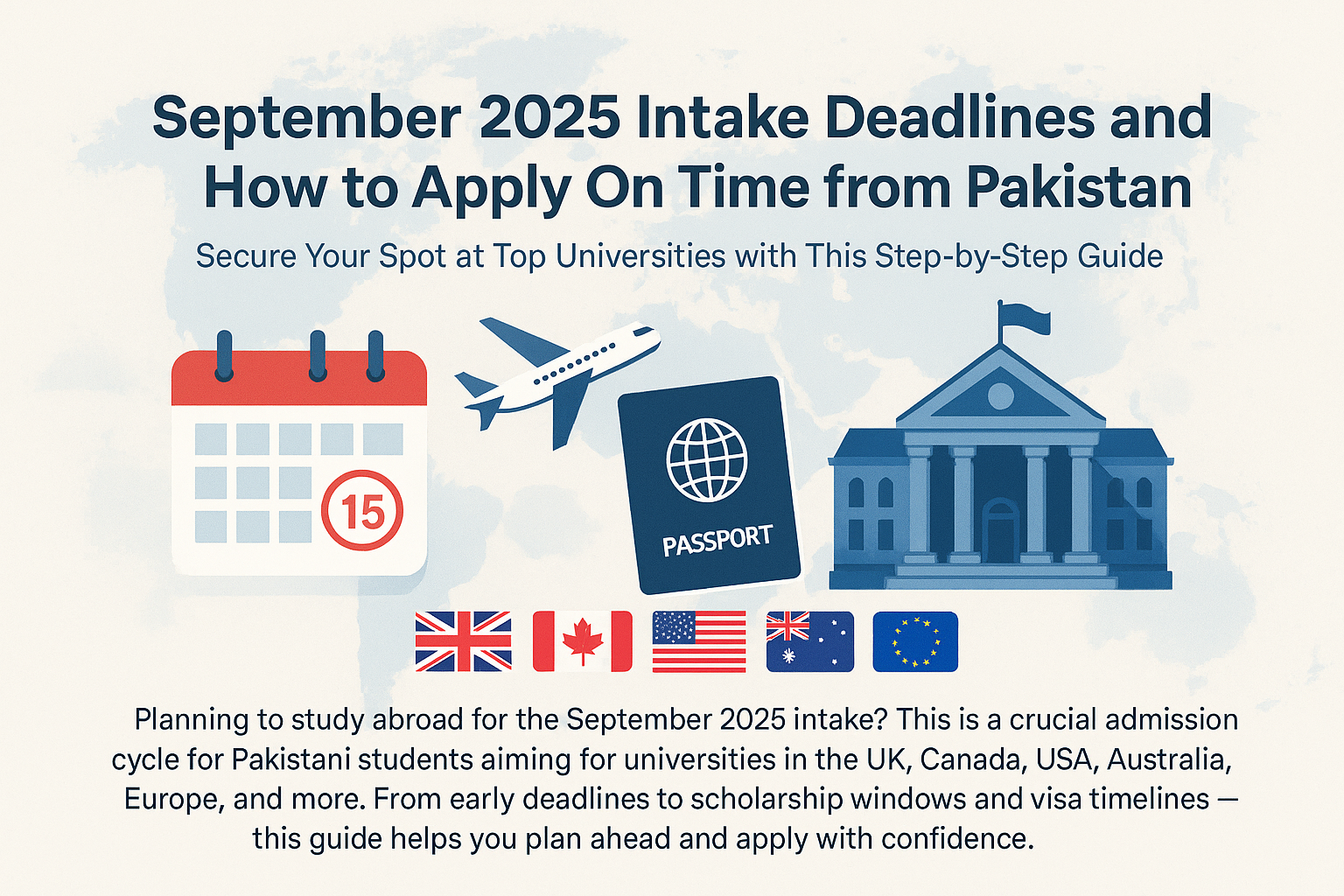
Planning to study abroad for the September 2025 intake from Pakistan? This is one of the most crucial admission cycles for students from Pakistan aiming to secure spots at top universities worldwide. With a broad range of programs and scholarship opportunities available, understanding September 2025 intake deadlines and preparing early can make all the difference. This guide walks you through what you need to know to meet deadlines confidently and avoid last-minute stress for the September 2025 intake Pakistan.

Why the September 2025 Intake is a Game-Changer

The September intake is the main academic session across popular destinations like the UK, Canada, USA, Australia, and Europe. Here’s why it matters to students applying from Pakistan:

  • Wide Course Availability: Nearly all undergraduate and postgraduate courses open during this period.
  • More Scholarship Options: Most universities allocate the bulk of scholarships to this intake.
  • Adequate Preparation Time: After finishing your FSC or A-Levels, you’ll have enough time to get your documents and tests ready.
  • Comprehensive Orientation & Support: Universities host detailed orientation programs and support services for new students.

For Pakistani students, the September 2025 intake is the most strategic time to apply abroad.

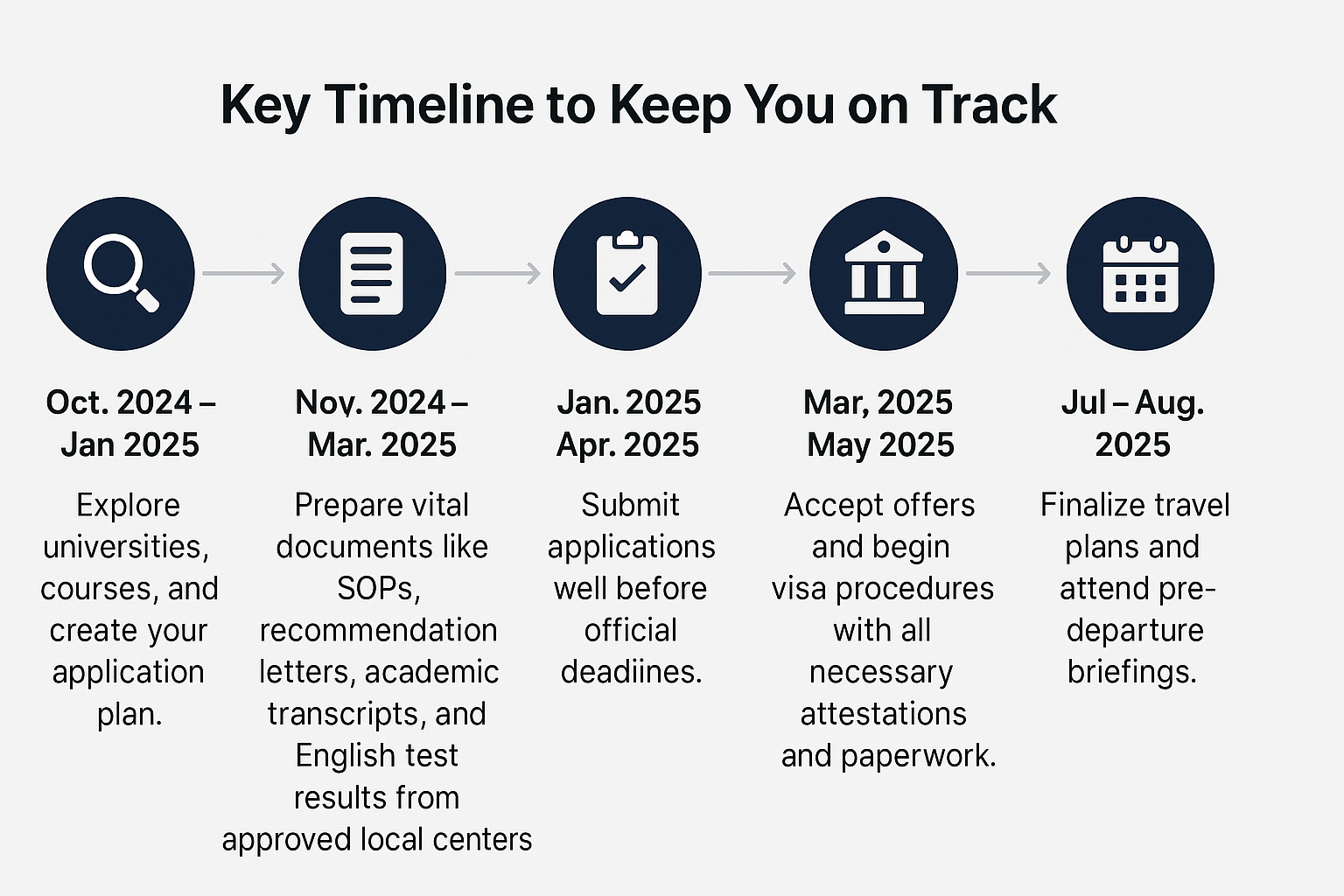
Key Timeline to Keep You on Track

  • Oct 2024 – Jan 2025: Explore universities, courses, and create your application plan.
  • Nov 2024 – Mar 2025: Prepare SOPs, recommendation letters, academic transcripts, and English test results.
  • Jan 2025 – Apr 2025: Submit applications well before official deadlines.
  • Mar 2025 – May 2025: Attend interviews (if required) and receive admission offers.
  • May 2025 – Jul 2025: Accept offers and begin visa procedures.
  • Jul – Aug 2025: Finalize travel plans and attend pre-departure briefings.

Country-Wise Application Deadlines to Watch

  • UK: UCAS Deadline: Mid Jan 2025 – Submit visa application by July 2025.
  • Canada: Jan – Apr 2025 – Start study permit applications early.
  • USA: Dec 2024 – Mar 2025 – Register for SAT/TOEFL early at local test centers.
  • Australia: March – May 2025 – Apply for student visa well in advance.
  • Europe: Feb – May 2025 – Ensure document attestations are completed timely.
  • Malaysia: Flexible till June 2025 – Visa process generally faster.

Steps to Ensure You Don’t Miss Deadlines

  • Choose Universities & Programs Wisely: Look for courses aligned with your goals and approved by your local education authorities.
  • Get Your Documents Ready: Complete necessary attestations and ensure your SOP and recommendations stand out.
  • Apply Ahead of Deadlines: Submit your applications at least 2–3 months before the official closing dates.
  • Stay Alert for Updates: Keep track of emails or messages about interviews and offer letters.
  • Finalize Your Offer and Visa: Prepare financial proofs and attend visa interviews with confidence.

Tips to Stay Organized and On Schedule

  • Use calendar apps popular locally to mark deadlines and reminders.
  • Begin preparations right after your exam results are announced.
  • Visit nearby StudyWES centers for expert advice and application review.
  • Attend education fairs and webinars for direct access to university reps.
  • Always have backup choices with rolling admission policies.

How StudyWES Simplifies Your Application Journey

We know the process can feel overwhelming. StudyWES provides:

  • Custom Planning: Tailored timelines aligned with your academic calendar and application deadlines.
  • Program & University Matching: Based on your profile, budget, and career goals.
  • Document Support: From drafting to attestation guidance and upload checks.
  • Deadline Monitoring: Timely reminders so you never miss a date.
  • Test Preparation: Assistance with booking and preparing for IELTS, TOEFL, GRE, and others.
  • Visa Assistance: Expert support for financial proof, document preparation, and interview coaching.
  • Pre-Departure Guidance: Travel tips, packing lists, and cultural orientation.
  • Local Presence: Offices in Karachi, Lahore, and Islamabad with consultants available by phone or WhatsApp.

Ready to Start Your September 2025 Application?

Apply with confidence and support every step of the way.

  • Call or WhatsApp: +92-321-8888850
  • Visit: StudyWES Lahore for a free consultation

April 29, 2025

Studying abroad is a dream for many Pakistani students, and 2025 offers even more exciting opportunities. With affordable tuition fees, higher visa success rates, and generous scholarships available, choosing the right destination is crucial. If you’re looking for the best countries to study abroad in 2025, you’re in the right place! In this guide, we’ll highlight the top countries offering bright futures, strong academic programs, and career opportunities for Pakistani students.


Why Choose to Study Abroad in 2025?

The world of international education has opened up significantly after the pandemic.

In 2025, universities are offering more scholarships, visa rules have become more flexible, and post-graduation work opportunities are expanding. Studying abroad enhances your global exposure, improves career prospects, and helps you build a future-ready skill set.

Why now?

  • Access to top-ranked universities globally
  • Affordable tuition in many countries
  • New and improved post-study work visas
  • Diverse, welcoming student communities
  • Scholarships dedicated to Pakistani and international students

Top 5 Countries for Pakistani Students in 2025

1. Canada

🎓 Why study here? Canada remains one of the top study abroad destinations for Pakistani students due to its welcoming immigration policies, multicultural cities, and world-class education system.

  • 💰 Average Tuition Fees: CAD 15,000 – 30,000 per year
  • 🛂 Visa Success Rate: High (especially through SDS stream)
  • 🎯 Top Universities: University of Toronto, University of British Columbia, McGill University
  • 💼 Post-Study Work Options: 2–3 years open work permit after graduation
  • 🎓 Scholarships Available: Lester B. Pearson International Scholarship

2. United Kingdom

🎓 Why study here? The UK offers quick visa processing, high-quality education, and a vibrant multicultural environment, making it one of the best countries to study abroad in 2025.

  • 💰 Average Tuition Fees: £11,000 – £22,000 per year
  • 🛂 Visa Success Rate: Very High for Pakistani applicants
  • 🎯 Top Universities: University of Oxford, University of Cambridge, Imperial College London
  • 💼 Post-Study Work Options: 2 years Graduate Immigration Route (extendable)
  • 🎓 Scholarships Available: Chevening Scholarships, Commonwealth Scholarships

3. Australia

🎓 Why study here? Australia is increasingly popular due to MOI acceptance (medium of instruction letters instead of IELTS) at many universities and strong career pathways after graduation.

  • 💰 Average Tuition Fees: AUD 20,000 – 38,000 per year
  • 🛂 Visa Success Rate: High (GTE-focused but favorable)
  • 🎯 Top Universities: University of Melbourne, Australian National University, University of Sydney
  • 💼 Post-Study Work Options: 2–6 years depending on qualification and region
  • 🎓 Scholarships Available: Destination Australia Scholarship

4. United States of America (USA)

🎓 Why study here? The USA offers world-class education, diverse programs, top research facilities, and endless career opportunities. It’s home to many of the world’s best universities and provides a multicultural experience.

  • 💰 Average Tuition Fees: $20,000 – $45,000 per year
  • 🛂 Visa Success Rate: Moderate to High (F-1 Visa with complete documentation)
  • 🎯 Top Universities: Harvard University, MIT, Stanford University, UC Berkeley, NYU
  • 💼 Post-Study Work Options: OPT (12–36 months for STEM fields)
  • 🎓 Scholarships Available: Fulbright Program, Knight-Hennessy Scholars, university-specific scholarships

5. Malaysia

🎓 Why study here? Malaysia is becoming a top choice for Pakistani students due to its affordable tuition fees, quality education, and cultural familiarity. Many Malaysian universities are ranked internationally, and the cost of living is very student-friendly.

  • 💰 Average Tuition Fees: MYR 7,000 – 25,000 per year
  • 🛂 Visa Success Rate: Very High (simple and streamlined process)
  • 🎯 Top Universities: University of Malaya, Taylor’s University, Sunway University
  • 💼 Post-Study Work Options: Graduate employability programs + internship pathways
  • 🎓 Scholarships Available: Malaysian International Scholarship (MIS)

How StudyWES Can Help You

Navigating the application and visa process alone can be overwhelming. That’s where StudyWES comes in!

  • 🎯 Free personalized consultation
  • 🎓 University and program selection
  • 💬 Complete visa file preparation
  • 💸 Scholarship and financial aid assistance
  • 🛫 Pre-departure guidance and support

Let’s build your future together!

📞 WhatsApp: +92 321 8888850

🌐 Website: www.studywes.com

×
Study Abroad